

Say “No” to the Six Stories – of Domination, Revolution, Isolation, Purification, Victimization and Accumulation. “Yes” to the Seventh Story of openheartedness.
Read Cory and the Seventh Story: A Children’s Book for Adults – Penguin Random House
Rural-Urban linkages
The Six-Story Reality – Lacking stable market links with nearby towns and cities, rural areas are often forced to sell their products at poor prices to far-flung markets.
Analysis – Productive Rural Areas need to establish long-term, stable market links with nearby towns and cities. This enables them to get improved prices and long-term contracts for produce, timber, fish, and other products. When producers are well known, and their products known to be of superior quality, they can differentiate themselves in the marketplace.
 Community Supported Agriculture (CSA) is a simple example. In this case, a farm offers its customers a chance to purchase a subscription share that runs through the growing season. Deliveries are made, typically weekly, either to a center location or subscribers’ homes, with an assortment of that week’s produce. This arrangement allows farmers to get very strong prices for their produce on a predictable basis and allows subscribers to get to know the farmers and the land responsible for their food.
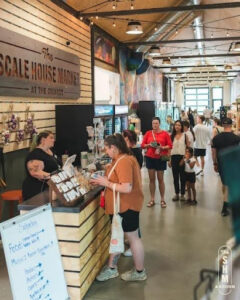
Farmers’ markets are extremely popular in the Inland Northwest with five or six in Spokane and many surrounding towns each having one too. These offer important market linkages, allowing farmers, beekeepers, bakers, and many others to sell their wares at good prices. The new Scale House Market in Spokane adds an all-year farmers market to the mix, offering a range of local crafts for sale too. Many farms offer visiting opportunities, with roadside stands or you-pick arrangements.
In recent years, many restaurants specializing in regional, seasonal, and organic ingredients have sprung up. Chefs Collaborative is promoting this approach to fine cuisine across the United States. Members of the Collaborative like Greg Higgins of Higgins Restaurant in Portland and Alice Waters of Chez Panisse in Berkeley seek out regional specialties at their peak taste, purchasing from the same suppliers year after year.
Sustainable Northwest’s Healthy Forests Healthy Communities Partnership is working to build rural economies based on forest restoration and ecosystem management. The Partnership is creating new markets for the small diameter suppressed trees and underutilized species harvested in restoration operations, producing flooring, furniture, crafts, fixtures, and other products, thereby creating jobs in communities adjacent to degraded forests. Rural-Urban Linkages like these make an important contribution to Local Economies.
The Seventh-Story Choice – Rural-Urban Linkages help rural producers get better prices for their goods and improve their financial stability. They also connect urban consumers with pressing issues and concerns for nearby rural areas.
Say “No” to the Six Stories – of Domination, Revolution, Isolation, Purification, Victimization and Accumulation. “Yes” to the Seventh Story of openheartedness.
Read Cory and the Seventh Story: A Children’s Book for Adults – Penguin Random House
7TH STORY CASE STUDIES
EXAMPLES OF THIS PATTERN IN ACTION
-
- LINC Foods (LOCAL INLAND NORTHWEST COOPERATIVE)
 LINC Foods is a worker and farmer owned food hub based in Spokane, WA. We envision the Inland Northwest with a robust local food system and a vibrant ecosystem.
Vision – We envision an inland northwest with a robust local food system, a vibrant ecosystem, and fair, fulfilling employment.
Mission – Building a regional, sustainable food system by linking local farmers to new markets and ensuring the highest quality products for our customers through democratic enterprise.
Values – Our values are based on democracy, equality, equity, and solidarity. We believe in honesty, openness, social responsibility, and cooperation.
Sustainability – LINC Foods is committed to delivering a sustainable product through requiring sustainable growing practices, reducing food miles, and finding markets for produce that would otherwise go to waste. - Weekly Farmer’s Markets
 Farmers markets are an economic lifeline for local farmers. Crates of lettuce, peas and corn. Cartons of fresh berries. Jars of honey and wedges of cheese. Eggs. Shoppers carrying brimming baskets and bags stroll among the booths, invigorated by the fresh air. They chat with neighbors and the farmers about the produce. For shoppers, the farmers market is an enjoyable alternative to the grocery store. But for farmers it is serious business. Spokane has several Farmers Markets and many surrounding small towns have one too.
Check out the list of weekly Farmers Markets in Spokane below. Supporting the one in your neighborhood brings vitality to the place you call home.
Fairwood Farmers Market
Kendall Yards Night Market
Emerson-Garfield Farmers Market
Spokane Valley Farmers Market
Thursday Market – South Perry Street
Millwood Farmers Market
Garland Summer Market
Liberty Lake Farmers Market - The Scale House Market (a year round Farmers Market)
 “We are growing so much food here in Eastern Washington,” Tyler said. “At the same time, we export over 89% of what we produce here. The food is leaving the local area, and at the same time we have local communities going hungry. That was a huge problem. And we said, ‘Well, how do we fix this? What are the needs? What do we have, and what do we not have?’ “
Four Roots connected with Vicki Carter, the director of the Spokane Conservation District, and began discussing ways to create sustainability in the local food program. The group recognized the area’s market culture, but also realized that for some farmers, stepping away from their farm to spend most of the day at a market while also keeping food at safe temperatures from the farm to the market and back wasn’t always feasible.
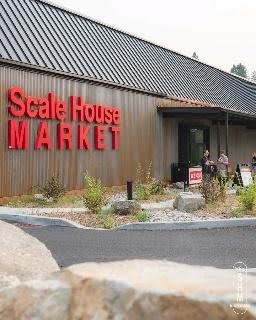
There began the rumblings for what would become Scale House Market, an indoor, year-round market where farmers and food producers could spend time at their booths, like Gimlin was during her interview with The Spokesman-Review, or simply drop off produce or products.
The market works more like a traditional store than a market during which you pay each vendor individually. At Scale House, you pick up what you need from as many booths as you’d like to visit then take it all to a cashier, who rings up your purchases. You can also grab a coffee and take a break in the market’s atrium.”
– By Azaria Podplesky for The Spokesman-Review. Read full article here. - Columbia Community Creamery
 At Columbia Community Creamery, every glass bottle tells a story of sustainability, local support, and innovation. Located in Chewelah, this nonprofit dairy is rewriting the script for how milk makes its way from farms to fridges—while keeping the community and environment front and center.Walking through the creamery’s doors, customers trade in glass bottles for fresh milk—thanks to a $3 deposit system that keeps the glass in constant circulation. “People bring in their bottles, and we refill them. It’s recycling glass bottles,” explained Executive Director Brittany Bilte. “We’ve found that glass bottles are extremely important to our customers—not just for environmental reasons, but they also keep milk colder and fresher.”
One standout feature: the first milk vending machine of its kind in the United States. “It’s very popular in Europe, and there’s one in Canada, but this is the first in the U.S.,” said Bilte. Customers can use tokens to refill their jars or bottles, reducing reliance on single-use plastics. So far, the effort has kept 1.7 tons of plastic out of landfills—a win for both the planet and the local community.
The creamery’s mission extends well beyond the bottle. Operating as a 501(c)(3) nonprofit run by a community board, Columbia Community Creamery links eight local farms: purchasing milk from three, supporting two others with market access, and sourcing eggs, bread, and beef from small producers. “We help farmers reach more customers and offer homemade products,” Bilte said. “It’s about supporting local producers and bringing fresher food to our community.”
The dairy’s products set themselves apart through traditional VAT pasteurization, gently heating milk to preserve its natural flavors while removing pathogens. “It’s not homogenized—you get cream rising to the top,” Bilte added. “You can skim it off for coffee or whipped cream, or just shake it in for rich, natural milk.”
Offerings include whole milk, half and half, chocolate and strawberry milks (the latter colored naturally with beet powder), café latte, yogurt, and cheeses, with plans to expand into cheese making in the coming year. All products are made with an emphasis on minimal additives and maximum freshness.
The creamery’s impact is not just economic or environmental—it’s educational. Visitors can watch the milk bottling process through viewing doors, and children flock to field trips where they learn how milk is made. “We offer classes on making mozzarella, other cheeses, and dairy products. Because we’re a nonprofit, we can keep class costs low and support local youth and agriculture,” Bilte said.
Community spirit is the creamery’s beating heart. Board member and dairy farmer Stacy Thomas explained, “We wanted to decentralize the supply chain for food security and help farmers get a fair price.” The creamery also partners with local markets like The Scale House, bringing their unique products—including signature ice cream and creamy café latte—directly to Spokane County customers.
Looking ahead, Columbia Community Creamery aims to expand its cheese production and educational outreach, building a model where sustainability, local agriculture, and community engagement go hand in hand. For this creamery, the future is local—and it’s looking pretty sweet.
- LINC Foods (LOCAL INLAND NORTHWEST COOPERATIVE)