

Green Building
The Six-Story Reality – Conventional buildings are wasteful of water, energy, and materials. They make use of toxic substances and have inferior indoor air quality. They are not oriented for passive solar heating or sited to improve the surrounding neighborhood fabric. They are not designed for eventual re-use and disassembly.
Analysis – Green Buildings, both new and retrofitted, are the cornerstone of Human-Scale Neighborhoods. They are designed for passive solar heating and cooling and therefore require smaller mechanical systems. They offer abundant natural light and a connection to seasonal rhythms. When possible, they produce and store their own Renewable Energy. They use non-toxic materials, paints, and finishes, which greatly enhances indoor air quality. Construction methods are Resource Efficient, and materials are chosen to be low in embodied energy, regional, and contain recycled materials. Wood is sustainably certified.
Green Buildings are designed to be adaptable to new uses, and their materials can easily be reclaimed at the end of their useful life. Construction waste is treated as a resource and completely recycled. Green Buildings are sited and designed to blend with neighboring buildings. They use native landscapes that minimize water use and are designed to filter and retain stormwater. They are designed to elevate the human spirit and create a profound Sense of Place. Given the range of objectives for Green Buildings, The U.S. Green Building Council has developed a certification system for measuring their performance.
Green buildings typically cost at most 10% more than comparable conventional buildings. They tend to be more comfortable, beautiful, and desirable in the marketplace. For instance, houses in Village Homes in Davis, California, a green neighborhood dating to the 1970s, are now worth 30% more than comparable nearby homes. Reduced operating costs associated with resource efficient building design may make ownership possible for some individuals who might not otherwise be able to qualify for a mortgage. Fannie Mae and others are now offering energy-efficient mortgages and location-efficient mortgages, which offer better terms for houses with lower utility bills and households with one or no cars.
The U.S. E.P.A. has ranked “sick buildings” as one of the top five environmental threats to human health. By using non-toxic materials and providing abundant quantities of fresh air, Green Buildings make a substantial contribution to human and environmental Health. Green Buildings also tend to enhance worker productivity.
The Seventh Story Choice – Create buildings which provide their own energy, purify their own waste, and participate in sustainable materials cycles. Make buildings flooded with natural light and fresh air, which makes people feel fully alive. Design buildings which heal part of the fabric of the world.
Say “No” to the Six Stories – of Domination, Revolution, Isolation, Purification, Victimization and Accumulation. “Yes” to the Seventh Story of openheartedness.
Read Cory and the Seventh Story: A Children’s Book for Adults – Penguin Random House
7TH STORY CASE STUDIES
EXAMPLES OF THIS PATTERN IN ACTION
1. Catalyst Building, Spokane
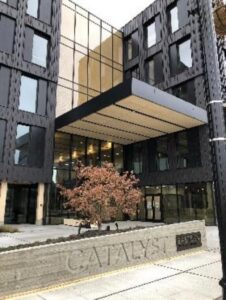
The new Catalyst building aims to be one of the largest zero-carbon, zero-energy buildings in North America, as certified by the International Living Future Institute (ILFI). The adjacent Morris Center will be the heart of an innovative shared energy model called an Eco-District, where a centralized plant will power the two new buildings and additional buildings in the future.
Check out a video of the Catalyst Building here
2. Blockhouse Life, Spokane
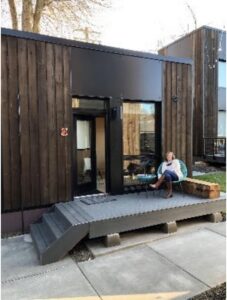
Our Blockhouses are net-zero designed and built from sustainable materials , creating a tranquility experience for our guests and planet.
Check out a video of Blockhouse Life here
Podcast: New Story Spokane interviews …