

Cultural Preservation
The Reality: Each time a language or culture is lost, we lose an irreplaceable and exquisite way of being. Each time a well-loved building is torn down without a trace, or a gathering place paved over, a strand of culture is frayed.
Analysis: Culture is the highest expression of what it means to be human. It is a measure of our species’ contribution to planetary Biodiversity. Cultural Preservation emphasizes the need to protect, restore, and honor all forms of Cultural Diversity. It is a cornerstone of Community.
Cultural Preservation recognizes the many strands of culture: language, stories, songs, dances, practical skills; buildings; sacred sites; artifacts; arts and crafts; relationships to the land; and forms of subsistence. In the context of the built environment, the appropriate re-use of well-loved and culturally significant buildings and sites can provide cultural renewal. Landscapes retain memories of old patterns of use, from the long trails of oaks planted across California for food and game; to the fire-maintained savannas of the Applegate now closing back in with forest; to the ancient salmon weirs on the British Columbia coast. These sites can be celebrated, and these patterns of use hold clues for twenty-first century management systems grounded in traditional ecological knowledge.
In Clayoquot Sound, British Columbia, a wide range of representatives from First Nations, governments, commercial fisheries, and environmental groups has formed the Regional Aquatic Management Society. This group is using local knowledge, some of it ancient, to manage local fisheries for the health of the whole ecosystem, and with benefits to flow fairly to all participants. Traditional cultural methods for managing ecosystems are extremely sophisticated and timely. They offer powerful models for monitoring, restoring, and sharing the benefits from ecological commons.
The Northwest School of Wooden Boatbuilding in Port Townsend, Washington teaches, and thereby preserves, a number of traditional maritime crafts, including fine wooden boatbuilding. The U’mista Cultural Center in Alert Bay, British Columbia, teaches the Kwak’wala language to a new generation. The Sitka Arts and Ecology Center in Neskowin, Oregon blends craft, fine art, and science. Such institutions keep the old arts and ways alive, blending them with the emerging Conservation Economy.
Goal: Find ways to keep the whole spectrum of cultural practices vibrant and alive.
CASE STUDY (A Seventh Story)
The Salish School of Spokane – Preserving the Salish language and culture
“Throughout the classrooms, hallways and playground, hardly a word of English is spoken, as students and teachers alike talk to each other in Salish, even when not in active instruction time.
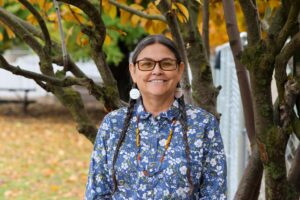
N̓ʔiy̓sítaʔtkʷ, whose English name is LaRae Wiley, Sinixt citizen of the Colville Confederated Tribes, is a founder and former executive director of the Salish School of Spokane. She is now serving as an elder linguist. She smiles for a photo on November 6, 2025. (Photo by Nika Bartoo-Smith, Underscore Native News / ICT)
There are 29 Salish languages throughout the region of what has been known as “Washington,” “Oregon,” “Idaho,” and “British Columbia.” Of those, there are 22 Coast Salish languages and seven Interior Salish languages, according to the Salish School of Spokane website.
At Salish School of Spokane the goal is the revitalization of the four Southern Interior Salish languages, with a focus on n̓səl̓xčin̓. The curriculum enables staff to teach both n̓səl̓xčin̓ (Colville-Okanagan Salish) and n̓sélišcn̓ (Spokane-Kalispel-Bitterroot Salish), bringing learners to an advanced level of fluency.” – Nika Bartoo-Smith Features, Okanagan
Read the full article here: At the Salish School of Spokane, a community of n̓səl̓xčin̓ speakers is built – Indiginews.